

When you make robot parts, exactness is everything. CNC machining for the robotics industry gives you that control. Every cut, hole, and shape follows your design exactly, regardless of material, metal, plastic, or composite. You know each part will fit and perform as expected.
CNC machines work better when paired with robots. You can have a robot load materials, swap tools, or check parts. This keeps production moving smoothly, reduces errors, and lets you focus on solving problems.
What is CNC Machining?
CNC machining lets you control machines with a computer instead of doing everything by hand. You program the machine with instructions, and it moves tools like drills, mills, and lathes with accuracy and repeatability. You can make simple parts like drilled plates or complex parts like robot joints, all with consistent quality.
How are CNC Machines and Robots Integrated?
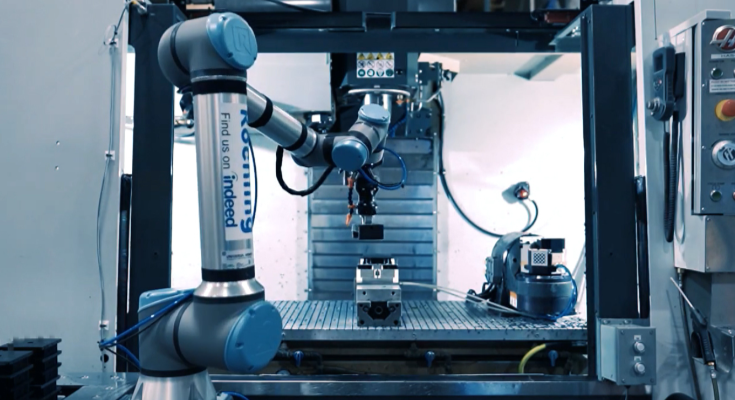
You integrate CNC machines and robots by letting them share the work. They work best when their tasks complement each other. This teamwork keeps the machine running longer with less downtime and without constant human supervision. You link their software and connect the robot’s program with the CNC controls so both follow the same instructions, and the process runs automatically.
Common Robot Components Made with CNC Machining
Robot Arms: These are the main moving parts of many robots. Each joint and link must be cut and shaped to exact sizes to make the arm move smoothly and line up with other components.
Jigs and Fixtures: You use these during manufacturing to hold parts steady. With CNC machining, you can count on them being made with high accuracy to keep all other robot parts consistent.
End Effectors: These are the tools at the end of the robot arm, such as grippers, welders, or cutters. CNC machining gives them the strength to interact with different objects, parts, or materials and carry out tasks without failure.
Controllers: The housings that protect the electronics of the robot. They need to be machined carefully to fit sensors, circuit boards, and connectors without issue.
Sensors: Robots use proximity or vision sensors. CNC machining makes the casings for these sensors, keeping them in the right position and well protected.
Chassis and Frames: They serve as the robot’s skeleton. They must be rigid and machined to the right size so other components can be mounted and attached properly.
Gears and Bearings: These parts may be small, but they are very important to keep your robot working smoothly. They need to be machined with exact measurements to fit properly, reduce friction, and last longer.
Actuators: Known as the muscle of robots, actuators give motion. For their housings and internal parts to handle heavy loads and stress without breaking, careful handling is necessary.
Housings and Enclosures: These parts protect delicate electronics and mechanisms inside the robot. CNC machining makes them tough, accurate, and shaped to fit everything securely.
Mounting Brackets: These may look simple, but they keep other components in place. If these brackets fail, the entire robot’s design and stability can be affected.
Types of CNC Machines Used in Robotics
CNC Mills

You use CNC mills to make complex parts with high precision. They move on three or more axes (X, Y, and Z) and can cut, drill, and shape materials into detailed designs. Mills are great for building robot bodies, gears, and frames from metals or plastics.
CNC Lathes
This type is best for round or cylindrical parts like shafts, hubs, and bearings. The material spins while a cutting tool shapes it, giving you balance and symmetry. This is key for robot joints and other moving parts.
CNC Routers
When you need to cut softer materials such as plastics, foam, or wood, CNC routers are the tool. They let you create panels, covers, and custom housings with fine detail.
CNC Plasma Cutters
Plasma cutters quickly cut through metal using a plasma torch. They are often used for robot frames, gears, and support structures. They help save time while keeping accuracy, particularly in mass production.
CNC EDM (Electric Discharge Machines)

EDMs use electrical sparks to cut and shape hard metals or create detailed cavities. They are useful for molds, dies, and other parts that are too complicated for other machines.
CNC Grinders
If your gears or robot arms don’t fit perfectly, they wear out fast. CNC grinders solve this by giving you smooth surfaces and tight tolerances, making sure every part lasts longer and works properly. They are usually used for gears, threads, and robot arms.
CNC Laser Cutters
Laser cutters use a focused laser beam to cut metals, plastics, and composites into detailed shapes. They are mostly used for brackets, lightweight structures, and panels with smooth edges.
CNC Waterjet Cutters
CNC waterjet cutters use high-pressure water mixed with abrasives to cut different materials without heat. They are perfect for heat-sensitive materials, making them useful for custom fittings and robot chassis.
Different Types of CNC Robots Used in Machining
Cartesian Robots

These are also called linear robots; they move along straight X, Y, and Z axes. They are great with flat surfaces, such as drilling, milling, or inspection. Its simplicity makes it easier to program and maintain.
Articulated Robots
These types have rotary joints, allowing them to move with different motions. They are very flexible and useful for more complex jobs like welding, polishing, or moving awkward materials. Their ability to reach difficult angles makes them popular in advanced machining setups.
SCARA Robots
Selective Compliance Assembly Robot Arm (SCARA) robots move in a horizontal plane with speed and precision. You usually use them for quick assembly, loading and unloading CNC machines, or transferring lightweight parts between operations. Their agility makes them a good fit for fast-paced environments.
Delta Robots
They have a spider-like arm designed to connect to a base. This allows very fast and accurate movements, perfect for sorting, inspecting, and assembling delicate parts right after machining. If your priority is speed and exact handling, delta robots are a strong choice.
Collaborative Robots (Cobots)

Also known as cobots, they are designed to work safely next to people. With built-in sensors and safety systems, they can help with assembly, machine tending, inspection, or finishing tasks. They are flexible and easy to program for many CNC applications.
Gantry Robots
These are also called Cartesian gantries; these robots move along a large fixed frame. They are strong, scalable, and can handle heavy lifting while still keeping precise control over large areas. You will often use them to move big sheets or blocks of material, as well as for accurate milling and assembly across wide workspaces.
Cylindrical Robots
These robots operate in a cylindrical work area. They rotate around a vertical axis and extend or retract to reach different points. This design is compact and well-suited for drilling, welding, or finishing round parts. They also work well in tight spaces where other robots may not fit.
Main Industries Utilizing CNC Robotics
Automotive

Robots take care of welding car frames, painting bodies with smooth finishes, and assembling parts. This speeds up your production and still be consistent.
Aerospace
You can use CNC robots to create lightweight and complex parts like turbine blades or fuselage panels. Their precision helps you meet strict safety and performance standards.
Electronics
Robots place tiny parts on circuit boards with steady precision. This cuts down on waste and helps you deliver reliable devices that meet today’s high demand.
Healthcare
If you are making medical devices such as implants, surgical tools, or diagnostic equipment, robots can give you the exactness you need to comply with strict regulations and patient safety requirements.
Metal Fabrication

Robots cut, bend, weld, and assemble heavy metal parts. They lower manual risk, speed up production, and make sure every part fits together the way it should.
Woodworking
CNC robots let you shape, cut, and carve wood quickly. You can create detailed furniture, panels, or custom designs without losing quality.
Food and Beverage
Robots handle packaging, palletizing, and loading. They keep the process clean, safe, and efficient, which is critical when you are working with hygiene and large-scale output.
Plastics and Polymers
Robots manage molding, trimming, and extrusion with ease. This helps you make strong, uniform plastic parts for everything, from containers to automotive components.
Advantages of Using CNC for Robotics

- You get precise cuts and shapes that keep every robot part within tight limits.
- Repetitive jobs that most of the time take hours by hand are done in minutes. The robots don’t get tired, so you save time and finish more work in less time.
- Every part comes out the same. This reduces the risk of defects and means you don’t have to worry about one part fitting differently from the next.
- You can keep up with high demand without slowing down, allowing you to hit deadlines without stress.
- You can program them to switch tasks without the need for heavy retooling.
- Because the cuts are precise, no extra raw materials are wasted. That lowers costs and makes your process more sustainable.
- Regardless of the size you’re making, the same setup works. Scaling up is simple.
- Automated work is steady and reliable. You know what to expect, making planning and scheduling easier.
- Robots can handle heavy, repetitive, or risky jobs. Keeping workers safe and letting them focus on tasks that need skill, creativity, and decision-making.
- The setup cost may be high, but the long-term payoff is big. You save on labor, mistakes, and make your production faster.
- Changing designs is easy. Just simply update the program, and you can produce custom parts without major delays.
- Robots can run nonstop in conditions where people cannot, like heat, dust, or long shifts.
Limitations of CNC Robotics for Machining
- Buying CNC robotic systems is expensive, which can be tough for small and mid-sized businesses.
- Getting the system running takes technical skill. Without in-house experts, it can feel overwhelming.
- To keep them working smoothly, you need regular maintenance, which adds cost and downtime.
- Robot replaces some manual tasks. It means fewer jobs for people.
- They work best for repetitive, structured jobs but struggle with work that needs flexibility and judgment.
- Even with automation, you still need trained operators to handle setup, troubleshooting, and repairs.
- If the robot breaks or needs service, production can stop, which might affect your schedule.
How are Robots Used for CNC Machine Tending?
Loading and Unloading

Robots place parts in the machine and remove them when done, helping you cut cycle times and boost output.
Tool Changing
Instead of stopping the production for manual changes, robots can switch tools automatically, keeping your operations efficient.
Quality Inspection
Robots with vision systems can check parts while they are still being made, allowing you to see problems early.
Secondary Processes
After machining, robots can take care of tasks like deburring, washing, or packing, keeping your workflow organized.
What are the Alternatives to CNC Robotics?
Manual Machining

This needs more labor, takes more time, and is not as consistent, but it is less expensive. It works best for custom jobs or very small batches.
PLC Systems
Programmable Logic Controllers are good for automating simple and repetitive tasks. They also cost less than robots, but cannot handle complex jobs.
3D Printing
Also called additive manufacturing, it builds parts layer by layer. It is great for prototypes, custom shapes, and complex designs, but it is much slower and less efficient for large batches.
AGVs
Automated Guided Vehicles move materials around your shop floor. They cut labor costs and boost efficiency, but they do not actually handle machining like robots do.
CNC Machines vs CNC Robotics
Both of them help automate manufacturing, but they don’t do the same thing.
CNC machines are fixed machines that handle specific jobs like cutting, milling, or drilling. You program them to perform precise operations on a workpiece, but they can only do the tasks set up with their tools.
CNC robotics uses robots together with CNC technology to do more than just machining. Robots can move, handle, and even assemble parts. You can reprogram them and change tools, giving them much more flexibility than a single CNC machine.
Conclusion
CNC machines give you precision, while robotics brings flexibility. Together, they let you save time, cut costs, and boost output without adding extra labor. Robots handle loading, unloading, and quality checks, keeping your machines running smoothly around the clock. With fewer stoppages and faster turnaround, your shop gets more done with less effort.
Contact RobotCNCParts today, and we will provide the right solution and ensure smooth, reliable production.
FAQs
What are the most important considerations when using CNC for robotics?
You need to focus on control, repeatability, and system integration. The setup must match your production needs, including part size, material, and complexity. A properly planned workflow will guarantee a reliable output.
How long does it take to implement CNC robotics?
Implementation usually takes a few weeks to several months. The timeline depends on your system’s complexity, integration with other machines, and the level of customization required.
What are the maintenance requirements for CNC robotics?
Maintenance involves regular inspections, software updates, and calibration of moving parts. Daily checks for wear, lubrication, and alignment help prevent downtime and keep the system working properly.
How much does it cost to implement CNC robotics?
Costs vary widely depending on the scale and technology. Small setups may cost thousands of dollars, while large, advanced systems can run into hundreds of thousands. The investment pays off through faster production, reduced errors, and long-term savings.
See our custom robotic components.


