

If you’ve had to specify joints for industrial robot arms, then you’ve most likely had to select between RV reducers and harmonic reducers. While both are the most widely used, understanding their differences, how they work, and choosing the right one is critical to preventing failures.
What are RV Reducers in Industrial Robots?
These are gear reduction and transmission systems used in heavy-duty industrial robots to generate high torque and reduce speed. They utilize a cycloidal gear mechanism and a planetary gear stage and ensure high rigidity and shock resistance across several applications.
How do RV Reducers Work?
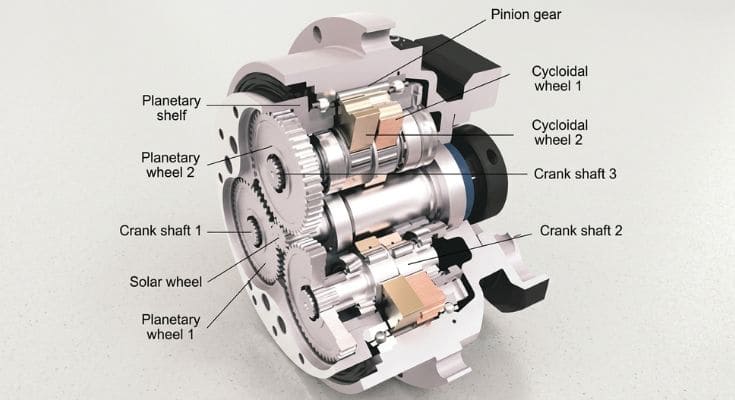
RV reducers work through a combination of a planetary gear stage and an eccentric cycloid stage. First, the motor drives the input shaft and helps transmit power to the planetary stage.
As a result, there is a decrease in speed and an increase in torque. A cycloidal disc rotates through several pins organized in a circular pattern. When the disc moves, the interaction between the cycloidal profile and the pins causes an extra reduction ratio. This creates a very rigid, high-torque output.
Advantages of RV Reducers

High Torque Capacity
RV reducers are capable of transferring a significant amount of torque. Since several pins share the load at a time, force is distributed across many points rather than on a few gear teeth. As such, it can handle heavy payload without wear.
Excellent Rigidity
Their housing and output bearing structures also provide good torsional rigidity. This reduces elastic deformation when applied force is involved.
Long Service Life
The design of the drive system, including its strong metallic structure and load-sharing process, helps ensure consistent performance for long hours while preventing wear.
Strong Shock Load Resistance
Industrial robots go through unexpected impacts and accelerations, and as such, RV reducers help absorb impact and stress, thereby preventing failure or damage.
Stable Performance in Heavy-Duty Applications
Whether they are used in automotive applications or complex assemblies, they maintain consistent torque transmissions and positional accuracy for a long time. And this makes them important in high-payload industrial robot usage.
What are Harmonic Reducers in Industrial Robots?
Also called strain wave gears, these are compact power transmission devices and gear reduction systems used in industrial robotics. They consist of a wave generator, flexspline, and circular spline and use controlled elastic deformation to achieve a high reduction ratio.
How do Harmonic Reducers Work?
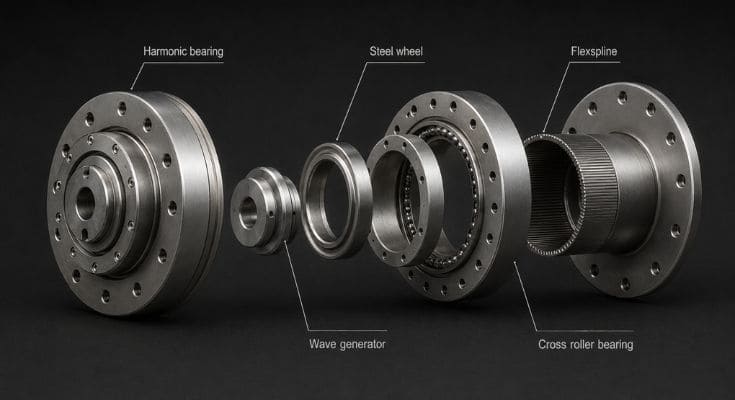
This works based on the principle of elastic deformation and uses three main components, including a wave generator, flexspline, and a circular spline.
The wave generator rotates and causes the flexspline to deform into an elliptical shape. So the teeth engage with the circular spline at two axes at the same time. With that, a high reduction ratio ranging from 30:1 to 160:1 is created.
Advantages of Harmonic Reducers

High Positioning Accuracy
The consistent tooth engagement reduces transmission errors and allows for effective movement control.
Compact and Lightweight Design
Because of their small and lightweight nature, they are vital for industrial robot applications where weight and space reduction is crucial.
Near-Zero Backlash
Backlash is the small amount of motion generated before a gear engages. Because of their continuous tooth contact, backlash is very minimal and sometimes close to zero.
High Reduction Ratios
Capable of achieving high reduction ratios within a single compact stage. It is known to generate ratios of 100:1 and 160:1.
Ideal for Precision Motion Control
Applications like collaborative robots, inspection, manufacturing, and medicine need exact motion control. Its low backlash and compact nature eliminate errors when in use.
RV Reducers and Harmonic Reducers: Key Differences
Here is a table describing the differences between the two reducer types.
| Comparison Features | Harmonic Reducer | RV Reducer |
| Size and Weight | Compact and Lightweight | Larger and Heavier |
| Structural Design | Wave generator and Flexible | Cycloidal/Planetary |
| Backlash | Near Zero | Low but greater than harmonic |
| Torque Capacity | Moderate | High |
| Rigidity | Low ( Flexspline is elastic) | High ( very Rigid structure) |
| Shock Load Resistance | Low | High |
| Cost | Low | High |
| Positioning Accuracy | Very High | High |
| Reduction Ratio | 30:1 to 160:1 | 57:1 to 192:1 |
| Typical Joint Application | Wrist and End Effectors | Shoulder, elbow, base. |
Where RV Reducers are Used in Industrial Robots
Base and Shoulder Joint: Since these joints carry the weight of the entire robot arm and payload, they must maintain good rigidity and torque output.
Heavy-Payload Robot Systems: Automotive, welding, and material handling systems need the reducer to resist load changes and impact.
Machine Tool Rotary Tables: The reducer is used here since it provides high rigidity under extreme cutting forces. This ensures stability and prevents shifting.
Where Harmonic Reducers are Used in Industrial Robots
Humanoid Robots: They are used for robot arms, fingers, legs, etc., due to their high power-to-weight ratio.
Collaborative Robots: Cobots require compact and low-weight joints for safety and easy mobility among humans.
Medical and Surgical Applications: Mistakes and errors must be eliminated in surgical robot arms and imaging machines, and this reducer helps ensure such precision.
Optical Tools and Semiconductors: These applications need exact positioning accuracy, and harmonic reducers provide near-zero backlash that aids this
How to Choose Between RV Reducers and Harmonic Reducers for Industrial Robots

When you require a reducer for a low-weight, compact application together with minimal backlash and high accuracy, consider harmonic. Beyond that, they are a perfect option for wrist joints and end effectors and also offer low cost.
If, on the other hand, your application involves heavy lifting or load, high torque, or shoulder, base, and elbow joints, RV reducers become the perfect option as they offer durability under continuous long-term use. When rigidity and shock resistance matter, they are also vital. However, they are more expensive than harmonic reducers.
Conclusion
While harmonic reducers are used in collaborative and humanoid robots, surgical and medical operations because of their small size and mass, and precision, RV reducers are used in heavy-duty robot systems due to their high resistance to shock load and rigidity, etc.
RobotCNCParts offers highly durable and quality robot components. From reducers and gear parts, structural frames, to heat sinks and sensor mounts, we offer no minimum order quantity and global delivery. Our production procedures are thoroughly inspected and traceable, ensuring every product meets industry standards. Contact Us Today.


