

We use anodizing for robotic parts to improve durability without adding weight and complexity. In robotic systems where parts are constantly under stress, surface quality often plays a major role in determining how long those parts last in the field.
In this article, you will learn how anodization occurs in robot parts, the type of anodizing that we use, and which materials are best for anodization. We will discuss various coatings, design considerations, the practical applications, and common mistakes to avoid.
What is Anodizing?
Anodization is a technique used to enhance the function as well as appearance of metallic components. While it is mostly practiced on aluminum, it may also be performed on other metals, including titanium, copper, magnesium, and zinc. The reaction differs between the metals; however, the purpose remains the same – to strengthen the metal.
The treatment results in the creation of an oxide film on the surface of the metal. This film protects the metallic component from damage and degradation. For this reason, anodization is widely used in manufacturing and CNC machining.
Benefits of Anodizing for Robotic Parts
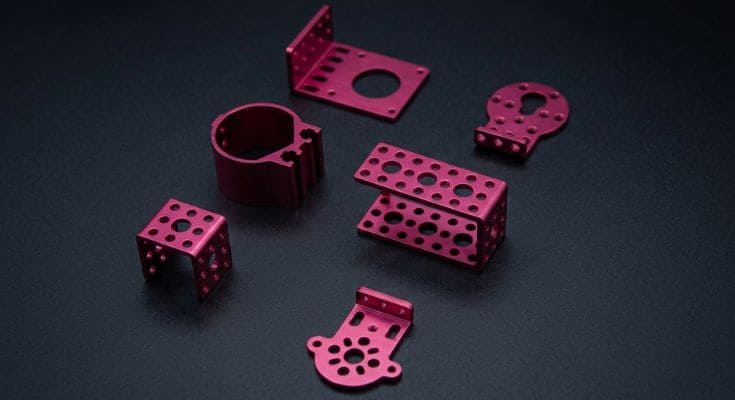
With robots, surface failures are likely to occur before any structural limitations. By anodizing, we increase the strength of this surface layer without affecting its fit, weight, or accuracy.
Some benefits of anodizing for robotic parts include:
High abrasion resistance: Anodic coating of Type III can achieve hardness close to hardened steel (~60-70 HRC) and decrease surface abrasion in mechanical parts.
Increased corrosion resistance: A properly sealed anodic coating can withstand more than 1,000 hours, sometimes 3,000 hours, of salt spray testing, enabling its use for robots operating under harsh conditions.
Adjustable Coating Thickness: Type II anodic coating is usually 5 to 25 µm, whereas type III anodic coating is 25 to 100+ µm. This provides us with control over coating thickness to balance protection and tolerance.
Superior electrical insulation (dielectric oxide film): The oxide film acts as an effective electrical insulator, ensuring proper integration of sensors, wires, and electronic components into the robot’s construction.
Reduced surface friction and improved behavior: Anodic coating may help minimize friction and even be used for PTFE sealant applications, enhancing mechanical movement in sliding or contact areas.
High-performance gain with negligible weight increase: Being a surface treatment, anodic coating does not affect the mass of a treated surface, which is especially important for dynamic robot elements.
Color coding and visibility: Because anodizing type II porous structures absorbs dyes, they can be color-tagged and used consistently for part assembly, maintenance, and identification.
Non-Toxicity: The anodized coating is safe for consumer products and is non-toxic.
Maintenance: The surface is easier to keep clean and maintain.
Types of Anodizing for Robotic Parts

Now, let us explore the features of different types of anodizing for robotic parts:
Type I Chromic Acid Anodizing
There is a formation of a thin (0.5-1 µm) oxide layer, with only minimal dimensional changes involved. Perfect for mounting precision low-wear robotics components.
Type II Sulfuric Acid Anodizing
This is the most prevalent method of treatment, producing a layer of 5-25 µm oxide. It is the right level of corrosion protection, electrical insulation, and dyeing potential. For serviceable applications that undergo moderate usage.
Type III Hard Anodizing/Hard Coat
This produces a 25-100 µm thick barrier oxide film with a highest attainable Rockwell Hardness of 70HRc, shielding the substrate. A great selection for highly strained robotics parts, including gears, slides, and bearing robotic parts. It even enhances fatigue life.
Type II and III Hardcoat anodizing could increase the life of the parts up to 2-5 times in contrast with that of untreated aluminum alloys.
Suitable Materials for Anodizing Robotics Parts

Aluminum
This is the most commonly used metal for anodizing robotic parts. This is because aluminum anodizes readily, forming a protective, extremely hard oxide layer on the component’s surface. This metal is also affordable and ideal for creating prototypes or mass-produced products.
Titanium
This metal anodizes to form an extremely hard, wear-resistant oxide coating. When titanium pieces are anodized, colorful oxides form on their surfaces, which can then be used to designate robotics parts.
Magnesium
Anodization can improve the physical qualities of magnesium alloy products. Anodized magnesium might be an ideal choice for drones or aerobot assemblies. Furthermore, specific electrolyte solutions can be used to prevent pitting and non-uniform anode coatings during magnesium anodizing.
Zinc
This material is not commonly anodized, although it can be anodized to improve corrosion resistance and surface hardness, making it ideal for specialized applications. Zinc is frequently used in robotic housings, brackets, and fittings because it is less expensive.
Tantalum
Anodized tantalum is appropriate for usage in harsh or niche robot applications, such as chemical-handling robots, ROV components submerged underwater, and robots subjected to high temperatures. Tantalum is less commonly utilized in robots due to its high cost.
How Does Anodizing Work?
To begin manufacturing long-lasting, high-performance components, we clean the base material of any oils, dirt, or impurities that could prevent the coating from adhering properly to the metal’s surface.
After cleaning, we immerse the component in an electrically charged bath of electrolytic solution (sulphuric acid or chromic acid). During this phase, the component serves as the “anode,” and the chemical reaction at the metal’s surface caused by an electrical current running through the bath results in a layer of dense, hard oxide.
Performance Comparison: Anodizing for Robotic Parts vs. Other Coatings

Anodizing vs Painting
Paint is a surface coating that can chip or peel and is susceptible to mechanical stress, whereas anodizing is performed on the material itself, which significantly improves its performance.
Powder Coating Differences
This increases thickness but reduces precision. Powder coating is not recommended for tight tolerances or mating surfaces.
Chemical Film Analysis
Chemical films, sometimes known as conversion coatings, provide some corrosion resistance, while anodizing provides higher hardness and wear resistance.
Design Considerations for Anodizing for Robotic Parts
Dimensional Tolerance Management
With anodization, a controlled thickness will be gained (Type II, 5-25 µm; Type III (hardcoat), 25-100 µm). Around half of this amount will grow externally while the other half internally; therefore, machining must be done accordingly. In particular, the following must be kept in mind:
Press fits: Decrease the diameter of holes by the estimated internal growth (0.5× thickness)
Threads: Increase hole diameter or thread size by 0.05-0.1 mm for hardcoat anodization
These differences help us ensure that assembly does not become a problem for robot parts.
Essential Masking Requirements
Threads, seal faces, and electrical contacts are critical surfaces requiring special attention during anodizing. The material used should be able to withstand the temperature (60-80 °C) in sulfuric acid baths and provide a surface resistant to coating deposition even at the level of 100 µm (Type III). Proper masking allows the designed tolerance of functional surfaces to be maintained.
Rack Mark Placement
Anodizing is accomplished by making electrical contact with the workpiece via racks or clamps. Standard rack marks are 2-5 mm wide and 0.2-0.5 mm deep. The placement of these marks is strategically selected so that each workpiece will have current flowing through it uniformly, resulting in a consistent coating thickness and no stress points on the robotic component being anodized.
Applications of Anodizing for Robotic Parts

Anodized surfaces in high-performance robotics applications ensure that advanced industrial robotics systems operate accurately and experience reduced downtime. Below are some key advanced robotics examples where anodizing provides measurable benefits:
Robotic Arm Chassis
Provides greater durability at lower weights, enabling accurate component movement during constant work.
Specialized End Effectors
Minimizes wear when a robot grips and performs contact operations, increasing part longevity.
Internal Sensor Housings
Ensures electrical insulation and protection against dust, moisture, and any potentially corrosive substance.
Underwater ROV Chassis
Protects underwater vehicles from corrosion caused by saltwater in their operating environment.
Collaborative Robot Frames
Enhances the robot’s body durability while providing a sleek, professional appearance.
Pneumatic Vacuum Manifolds
Prevents corrosion of internal components and ensures unobstructed airflow for precise robot operation.
Common Mistakes in Anodizing and How to Avoid Them

Anodizing involves several factors that can affect the outcome, and errors can permanently ruin the anodizing finish. Throughout the years, we have developed a list of common problems and solutions.
Uneven Color: This usually occurs if the surface is not clean or the anodizing parameters are unstable. We keep the temperature and current constant and ensure that the cleaning process for every part is exactly the same.
Poor Coating Adhesion: The oxide layer may not adhere if there are contaminants or if it is not properly cleaned. We always clean the parts properly and use quality electrolyte baths for good adhesion.
Burning: Excessive current/poor agitation may burn the surface. We closely watch the current and stir the bath to distribute the heat.
Poor Corrosion Resistance: When the oxide layer is not sealed, corrosion protection decreases. We always seal parts well, most of the time in hot water or a sealing solution, to seal in the coating.
Wrong Film Thickness: Insufficient or excessive anodizing duration, or inappropriate acid concentration, can lead to inappropriate thickness. We modify the strength of the electrolyte and the time to obtain the desired thickness each time.
Surface Streaking: Non-uniform current or inappropriate racking may result in streaks on the surface. We rack properly and ensure the current is even on all surfaces.
We pay attention to these things to ensure we produce superior, uniform, and durable anodized finishes.
Conclusion
The anodizing process is capable of producing robotic parts by converting conventional metals into usable components. In our experience, selecting the appropriate type of anodizing, Type II for light use and Type III for tough use, is a key aspect of manufacturing robotic parts. The quality of the job done decides whether the coating fails or succeeds.
At RobotCNCParts, we ensure our anodizing processes make your components reliable and help your robots work harder and longer. Reach out to us.


