

I look at how each method serves precision, design complexity, and part integrity whenever I compare CNC machining vs 3D printing for robot parts. I am familiar with how both technologies are used in robotics as well as their difference in terms of performance, function, and engineering requirements.
I rely on both processes in my work because, while the subtractive method gives strength and accuracy, additive manufacturing allows design freedom. Understanding their difference and how they work is crucial for choosing the right process for your robotics journey.
How CNC Machining Works in Robotics
CNC machining is a process widely used by industries to produce high-precision robotic components. This subtractive manufacturing method starts with processing a huge block of metal or engineering-grade plastic.
The material is then shaped using cutting tools that run through multiple axes. The process also includes programming the toolpaths, feed rates, and spindle speeds to make them control the process with the right surface finish and dimensional accuracy.
This process produces fully dense robotic components with material properties that are ideal for load-bearing structural parts, joints, and housings that need to be stiff, thermal resistant, and with repeatable tolerances. It also has an advanced setup, which is the 5-axis, that enables it to machine parts with complex designs and geometries.
How 3D Printing Works in Robotics
3D printing is the opposite of CNC machining because, instead of reducing a block of material, it constructs robotic parts layer by layer or solidifies material only where needed. This additive manufacturing has common methods like Stereolithography (SLA), Selective Laser Sintering (SLS), and Fused Deposition Modeling (FDM). While the metal-based processes are Direct Metal Laser Sintering (DMLS) or Selective Laser Melting (SLM).
This method creates complex components, frameworks, integrated channels, and custom shapes that are often difficult or impossible to achieve in CNC machining. Polymer parts are commonly used for prototyping and lighter components, while metal 3D printing is for high-strength and high-performance parts. Although part sizes depend on the printer’s build, structure, and capacity, there are minimal design constraints compared to subtractive methods.
Comparison in Performance and Quality

When I evaluate the performance between the two methods, I carefully look at how each delivers surface integrity, dimensional accuracy, and mechanical stability. CNC machining offers tighter tolerances while consistently maintaining strong material properties.
On the other hand, the layer-based method of 3D printing makes the mechanical properties direction-dependent. But in another sense, additive manufacturing beats CNC whenever I need complex geometries and weight-optimized components. The choice depends on what the priority is between geometric freedom and precision.
Dimensional Accuracy and Tolerances
Tolerance control is critical in robotics, and in this department, CNC machining is the superior choice. With the help of modern systems such as 3-axis and 5-axis, I achieve tolerances as tight as ±0.01 mm. Though it still depends on the machine condition and material, the dimensional consistency is reliable because of the cutting processes’ rigidity.
With 3D printing, dimensional accuracy may vary per printer because each of them works differently. The one that produces the widest variation is the system that melts and lays plastics because the material can shape slightly as it cools down.
The printer that creates parts from heated powder tends to deliver more consistent dimensions because the powder that surrounds it supports the part as it shapes. 3D printed metals have better accuracy than plastic ones, but these metals often need finishing if the components require tight dimensions and tolerances.
Mechanical Strength and Material Integrity
Mechanically, CNC parts maintain material density and have predictable stress. That factor is crucial for components that are exposed to extensive loading and bending. It doesn’t matter whether I machine metals or plastics because the uniform mechanical properties are reliable.
With the additive method, the printed parts can have internal gaps and may not be evenly strong in all directions because of the way they were layered. In metal printing, the material is strong, but the structure on the inside may be uneven, and heat treatment is needed to optimize its full form. This is the reason why printed components’ characteristics may vary. It depends on whether they are made through molding or machining.
Surface Finish
CNC also stands out in surface quality. I consistently get a uniform, smooth finish straight from the machine, especially when using specialized tools with appropriate spindle speeds. This is important for critical components that require bearing seats or linear motion interferences.
3D printed surfaces have layer lines because the design is built incrementally. Most prints need sanding and smoothing, and in some cases, machining to achieve the desired finish needed for a specific assembly.
Comparison of Design Freedom and Complexity

3D printing gives me better flexibility in design freedom. Whenever I need complex channels, organic forms, and mounting features, the additive method clearly has the upper hand. On the other hand, CNC has its limits in terms of tool accessibility, cutting diameter, and fixture limitations.
Regardless, CNC still offers repeatability and precision that 3D printing cannot match without post-process finishes.
Geometry Limitations
CNC lacks the capability to reach delicate internal corners or deep pockets beyond what the available tools can reach based on their diameter and length. These intricate details, such as undercuts, require a more advanced arrangement like a 5-axis setup. On the other hand, 3D printing can handle these with ease because the entire detail is created additively. If there is one limitation in this method is large bridging spans and unsupported overhangs, which need support structures.
Part Consolidation
One of the biggest advantages of 3D printing is the ability to consolidate multi-component assemblies into one unit. It can print a structure with fewer joints instead of machining several pieces to put together. CNC does not support consolidation as widely as that because parts need to be accessible to cutting tools. Even in complex assemblies, it must be in multiple pieces to maintain machinability.
Comparison in Material Compatibility

Material compatibility has a share of challenges for both methods, but each has strengths, too. Additive manufacturing has a wide range of composites and polymers, and also has opportunities for metal powders, though mechanical outcomes may vary. CNC machining excels and gives dimensionally stable components using metals or high-performance plastics.
Metals and High-Performance Plastics
I frequently work with stainless steel, aluminum, titanium, brass, acetal, PEEK, and engineering-grade polymers. All these offer strength, rigidity, heat resistance, and predictable stress distribution.
With additive manufacturing, I am familiar with working with ABS, Nylon, TPU, glass-filled Nylon, and high-performing metal powders. The mentioned materials deliver reliable prints, though polymer parts usually don’t match the stability and strength of machined parts unless specifically engineered.
Material Waste
Since the CNC process removes materials from a block, it produces more waste. Chips are often collected and disposed of. But regardless, it is still cost-effective in terms of producing structural parts. 3D printing’s process only deposits materials where they are needed,d so it gives less material waste.
Comparison in Cost, Speed, and Scalability

Comparing costs and scalability, 3D printing is the more cost-effective option for single-unit prints or prototypes. While with CNC, it is more beneficial when scaling into bigger production runs. This method is unmatched in terms of rapid cycle runs and repeatable processes once tool paths and fixtures are reinforced.
Production Volume and Cost
3D printing avoids tooling costs, which is beneficial for smaller production. The only time the costs rise is when quantities increase. With CNC, once set up, it produces parts quickly and has a lower per-piece cost for medium to large productions.
Lead Time
3D printing offers quick turnaround for one-offs and prototypes because it can start printing almost right away. White CNC machining needs time to set up, select tools, program, and set up fixtures. Though the machining is undoubtedly fast and consistent.
When to Choose CNC 3D Printing or Both Methods for Your Robot Parts
When to Choose CNC Machining
Choose CNC machining when:
- Your designs have simple and uncomplicated geometries.
- You require high-thermal performance and unmatched mechanical strength.
- The project has a strict requirement for tight dimensional tolerances.
- It is a large-scale production, and cost-efficiency is not an issue
- You specifically need materials like high-precision components, such as aluminum, titanium, or stainless steel
When to Consider Metal 3D Printing
3D printing/additive manufacturing is preferred when:
- Your parts are impossible or hard to machine because of their complex design and geometries
- You need topology-optimized and light structural components, such as a bracket or heat exchangers
- You are using hard-to-machine, exotic materials such as cobalt-chrome or Inconel
- It’s only a small production run, and tooling costs are a concern
- The project needs design freedom for certain applications
When to Combine Two Technologies
A hybrid approach is best when:
- When you need to 3D print the complex core of a particular component
- When you need to CNC machine critical features to get precision tolerances
- You want to balance accuracy, design complexity, and functional performance for mission-critical parts
Robotic Applications: CNC Machining vs 3D Printing for Robot Parts
Production Workflow

For my workflows, both methods have the same starting point. When I design the part in CAD, I later make it a machine-readable format. When I get to move forward into the digital phase, the vision and the understanding become clearer.
Though CNC machining is automated, it needs me to choose the tools I need, the fixture setup, cutting parameters, and the material. With 3D printing, the job starts when the machine is loaded and can run unattended until it’s finished.
Material Compatibility
Both technologies have a wide range of material options, but understanding that their strengths differ is a must. CNC machining allows me to pick high-performance materials when I need the parts to be durable and thermal-resistant.
I can easily work with aluminum, stainless steel, and titanium. For 3D printing, I use materials like ABS, TPU, Nylon, among many other options. Ideally, the final say is always about whether you are after design adaptability (3D) or structural strength (CNC)
Dimensional Tolerance
CNC is unmatched when it comes to giving me the tolerances between ±0.025 mm and ±0.015 mm, based on what process or machine I will use. While for 3D printing, tolerances may vary. In essence, for critical robot parts that require high precision and dimensional tolerance, CNC remains my choice.
Geometry and Size
I prefer 3D printing in terms of geometric flexibility because it doesn’t have tool geometry constraints. I can produce parts with complex designs, internal paths, and delicate contours that machining may not deliver.
In terms of part sizes, however, CNC machining accepts sizable blocks of material and the 5-axis industrial system can handle extremely large components with ease, while 3D prints are only limited to their build volume.
Surface Finish
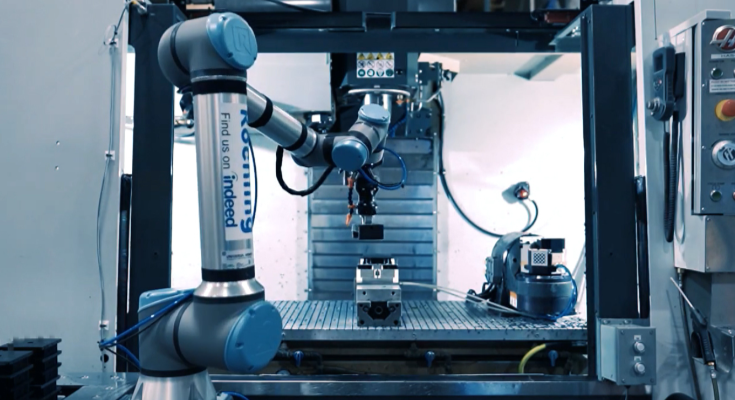
CNC machining gets things in a smooth finish right off the machine, ideal for surfaces that require a precision finish. 3D printing creates visible lines in layers that need post-processing to get the finish quality I expect in my robot parts.
Setup Cost
The setup cost is minimal for the additive method. A small machine can start around a few hundred. Even the industrial printers are less expensive because they require limited tooling. While CNC machining requires an expensive upfront cost for the equipment, tools, fixtures, software, and even skilled operators, it is only applicable for large-scale companies that can afford a costly upfront investment.
Cost of Products
3D printing is always more affordable for one-offs in minimal quantities. But when I need to scale production, CNC machining is the economical option because the process is repeatable, applicable for big batches, and extremely efficient.
Conclusion
Choosing between these two methods for your robot parts highly depends on the demands in terms of precision, performance, and geometry. Workflows that are big on accuracy and reliability rely on CNC machining. Choose additive manufacturing when the designs are lightweight and too complex to machine.
In RobotCNCParts, we offer accurate, production-ready components that will meet your high-precision robotic component needs. Reach out to our experts today so we can talk about how we make your robotic projects come to life.


